
An industry survey has showed that economic growth for the current fiscal may slip to 4.8 per cent from 5 per cent estimated earlier.

Planning Commission on Friday said it will revisit annual average GDP growth target of 8 per cent for the 12th Plan (2012-17) in view of dismal performance in first two years of policy period, while saying the economy is likely to expand by over 5 per cent this fiscal.

The economy may grow by around 7 per cent this financial year as estimated by the Monetary Policy Committee (MPC) of the Reserve Bank of India (RBI), say economists with various organisations. The first advance estimates for 2023-24 will be released on Friday by the National Statistical Organisation (NSO), an exercise done for calculating ratios such as the fiscal deficit. The interim Budget will be presented on February 1.

Short-term lending rate unchanged at 7.75 pc.

Capital expenditure by Indian companies is likely to see an uptick in the upcoming quarters as capacity utilisation has surpassed the critical threshold of 75 per cent, and numerous companies have deleveraged their balance sheets, according to analysts. The first quarter of the current financial year has shown improved profitability, driven by a decrease in input prices. This, according to analysts at Care Ratings, should stimulate a revival in the private capex cycle.
India's exports contracted by 22 per cent, the steepest decline in the last three years, to $32.97 billion in June on account of global demand slowdown, especially in the Western markets like the US and Europe. According to the data of the commerce ministry, the trade deficit in June stood at $20.3 billion against $22.07 billion in the same month last year due to a fall in exports and imports. The inbound shipments during the month under review declined by a steep 17.48 per cent to $53.10 billion.

The agency had received Rs 946.51 crore to manage its affairs in the Budget Estimates for 2023-24, which was later increased to Rs 968.86 crore in the Revised Estimates.

Throughout 2022, China turned to the PLA as an increasingly capable instrument of Statecraft, strengthening its ability to 'fight and win wars' against a 'strong enemy', points out Ajai Shukla.

Market hopeful of cash reserve ratio, interest rate cut today.

Indian economy is expected to improve marginally in the current financial year with its GDP at market price projected to expand by 3.4 per cent from 3.3 per cent in the previous fiscal, think tank OECD said.

Tactical investors should have an investment horizon of around six months to one year, long-term investors should stick around for 10 years or more.

The government has banned exports of onion till March next year with a view to increase domestic availability and to keep prices in check. "Export policy of onions... is amended from free to prohibited till March 31, 2024," the Directorate General of Foreign Trade (DGFT) said in a notification. Local vendors in the national capital are selling onions at Rs 70-Rs 80 per kg.

'The cost of financing the fiscal deficit will decrease, as new passive investors join in.'

Global rating agency Fitch on Friday pegged India's growth at 5.5 per cent in the current fiscal and 6 per cent in 2015-16 and affirmed the country's rating outlook at stable level.

The comments came after Indian Finance Minister Arun Jaitley warned of tough measures in his first budget on July 10, saying 'mindless populism' needs to be checked as India aims to boost growth.
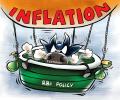
The Reserve Bank of India on Thursday marginally lowered its inflation projection for the current financial year to 5.1 per cent, as Governor Shaktikanta Das said the central bank's monetary policy actions are yielding the desired results. In April, the Reserve Bank had estimated the consumer price index (CPI) based retail inflation at 5.2 per cent during the fiscal 2023-24. CPI inflation fell sharply to 4.7 per cent in April 2023, from 6.4 per cent in February, on the back of favourable base effects, with softening observed across all the three major groups.

Budget has several small steps which will boost growth

Finance Minister Nirmala Sitharaman will be presenting her fifth Budget that may do a tightrope walk between staying fiscally prudent and meeting general public expectations of lower taxes and a wider social security net, while at the same time firing the engines of the economy.
In what could be a major relief to policy holders, LIC and other insurers are likely to absorb the 10 per cent service tax and 2 per cent education cess this fiscal.
However, independent economists are not as gung-ho as the finance ministry over the likelihood of deficit target being met this time around, says Indivjal Dhasmana.

'India's emergence as a top crypto market comes despite a regulatory and tax environment that can be challenging for the industry to navigate.'

Reminiscent of the past two years, the market has made positive strides ahead of the Union Budget 2023-24 (FY24). The benchmark National Stock Exchange Nifty has gained 1.8 per cent in the last month. Typically, markets tend to gain ahead of the Budget as investors build in optimism.

The broader NSE Nifty too slipped by 9.50 points, or 0.09 per cent, to end at 10,118.25

In the Sensex pack, Hero MotoCorp, IndusInd Bank, Bajaj Auto, Maruti and M&M were the top gainers, spurting up to 2.66 per cent.

FDI into the country increased by 30 per cent to $21.62 billion during April-September this fiscal.

In his maiden Budget presented in Parliament on July 10, Finance Minister Arun Jaitley has tried to provide relief to the middle class by increasing tax exemption limit by Rs 50,000 to Rs 250,000.
More rate cut by RBI unlikely this fiscal, say Ind-Ra
India's rampant inflation remains a hotly debated puzzle.
Finance Minister Arun Jaitley is keen to come out with reforms that can help cut fiscal deficit.
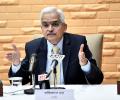
The Reserve Bank of India (RBI) on Wednesday raised the benchmark lending rate by 35 basis points to 6.25 per cent in a bid to tame inflation, which has remained above its tolerance level for the past 11 months. With the latest hike, the repo rate or the short-term lending rate at which banks borrow from the central bank now has crossed 6 per cent. This is the fifth consecutive rate hike after a 40 basis points increase in May and 50 basis points hike each in June, August and September.

IMF's Chief Economist Gita Gopinath on Thursday said it would be damaging for India to start tightening policy support in the midst of the COVID-19 pandemic and also stressed on reducing wasteful expenditures in the upcoming Budget. Delivering NCAER's '9th C D Deshmukh Lecture' virtually, Gopinath said there is scope for the Indian government to provide more direct support to people.

Modi said that for nearly one and a half years he has been putting in place details of new schemes to give new pace to the country's development and curb poverty.

Markets are assuming that by the second half of 2021, the world will be approaching some type of normalcy, points out Akash Prakash.
.jpg)
The central bank will come out with two measures on restructuring to tackle financial stress, Rajan said.

The government may have to resort, eventually and however unwillingly, to printing money, abandoned as policy and practice in the 1990, predicts T N Ninan.

'With China falling out of favour, India is where investors see the demographic and digital dividend apart from the benefits of reforms playing out.' 'Your prime minister has also done a great job of sharing this story with the world.'

India's real GDP growth will decline marginally to 6.3 per cent in 2024 from the 6.4 per cent estimated for 2023, an American brokerage firm said on Monday. The next calendar year will be of two halves, wherein the government spending before the upcoming General Elections will be the key driver for growth, while after the elections, it will be the re-acceleration in investment growth, especially from the private sector, Goldman Sachs said in a report. From a fiscal year perspective, the brokerage said it expects growth to accelerate to 6.5 per cent for FY25 from the 6.2 per cent it has projected for the ongoing FY24, it added.

Inflation target remains 5% for January 2017.

The spike in food prices at the onset of the monsoon season has corroborated the Reserve Bank of India's (RBI's) view that the fight against inflation is far from over, the State of the Economy report of the central bank said. At the same time, the report said that the country is poised to become the fastest-growing major economy in the world, notwithstanding some sequential moderation in economic activity in June. Consumer Price Index (CPI)-based inflation rate increased to 4.8 per cent in June 2023, from 4.3 per cent in May, primarily on account of an increase in food inflation.
 © 2026 Rediff.com - Advertise with us - Disclaimer - Privacy Policy - Sitemap - Feedback - About us - Terms of use - Grievances